






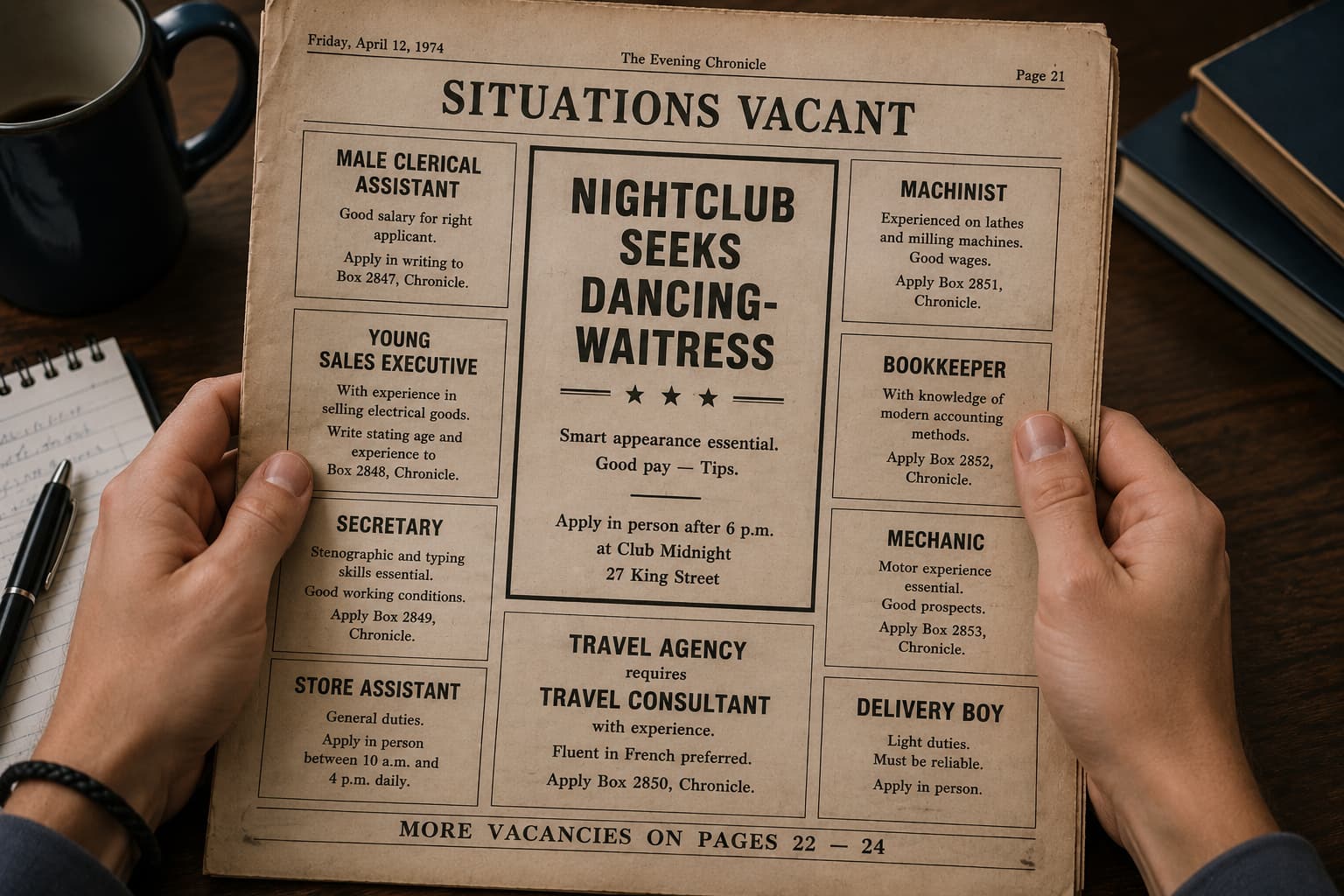
“Nightclub Looking for a Dancing Waitress.” This job advertisement immediately caught my attention. We are in the 1990s, and at the time I was a working student. Zurich’s nightlife had just been liberalised somewhat, and ten clubs had received permission to stay open until four o’clock in the morning on Friday and Saturday nights. I absolutely wanted to work in one of those clubs.
Peter Näf
Zurich, September 2026
Quite obviously, there was one requirement I did not meet: I was a man. But I knew I could wait tables. That seemed more important to me than my gender. I applied, was invited for an interview, and got the job as the only man in an otherwise all-female service team.
When I changed careers two years later, half of the service staff were men. The club manager had changed his view of what an ideal service employee looked like. His first male waiter regularly achieved the highest sales figures.
Job ads don’t tell the whole story
You do not have to become a game changer and overturn gender stereotypes. But job profiles are often more flexible than they appear at first glance, and companies can be surprisingly open to different backgrounds – as the following example illustrates.
Many years ago, I worked on a recruitment assignment for a bank as a headhunter. Together with the HR manager, I met the hiring manager, who described the vacant position to me. When I asked about the requirements, he replied: “A university degree and two to three years of experience in the field.” The labour market was extremely tight at the time, so I tried to broaden the candidate pool. “Would a university of applied sciences degree also be acceptable?” After a moment’s thought, he agreed, but required more practical experience in return.
At that point, the HR manager joined the discussion. She knew how difficult it was to find suitable employees. “But Hans, the previous job holder didn’t have a higher education degree either. Is it really a requirement?”
Job profiles are rarely set in stone
And then the floodgates opened. Suddenly, a wide variety of candidate profiles became conceivable. Someone with specialised expertise no longer needed a university degree. The longer we discussed, the more possible candidate profiles emerged. And what requirements ultimately appeared in my job advertisement? “University or university of applied sciences degree with two to five years of experience.”
It would have been impossible to describe every conceivable profile, so I focused on the wording that would appeal to the largest proportion of potential candidates.
That is why, to this day, I take job advertisements seriously—but never literally.