






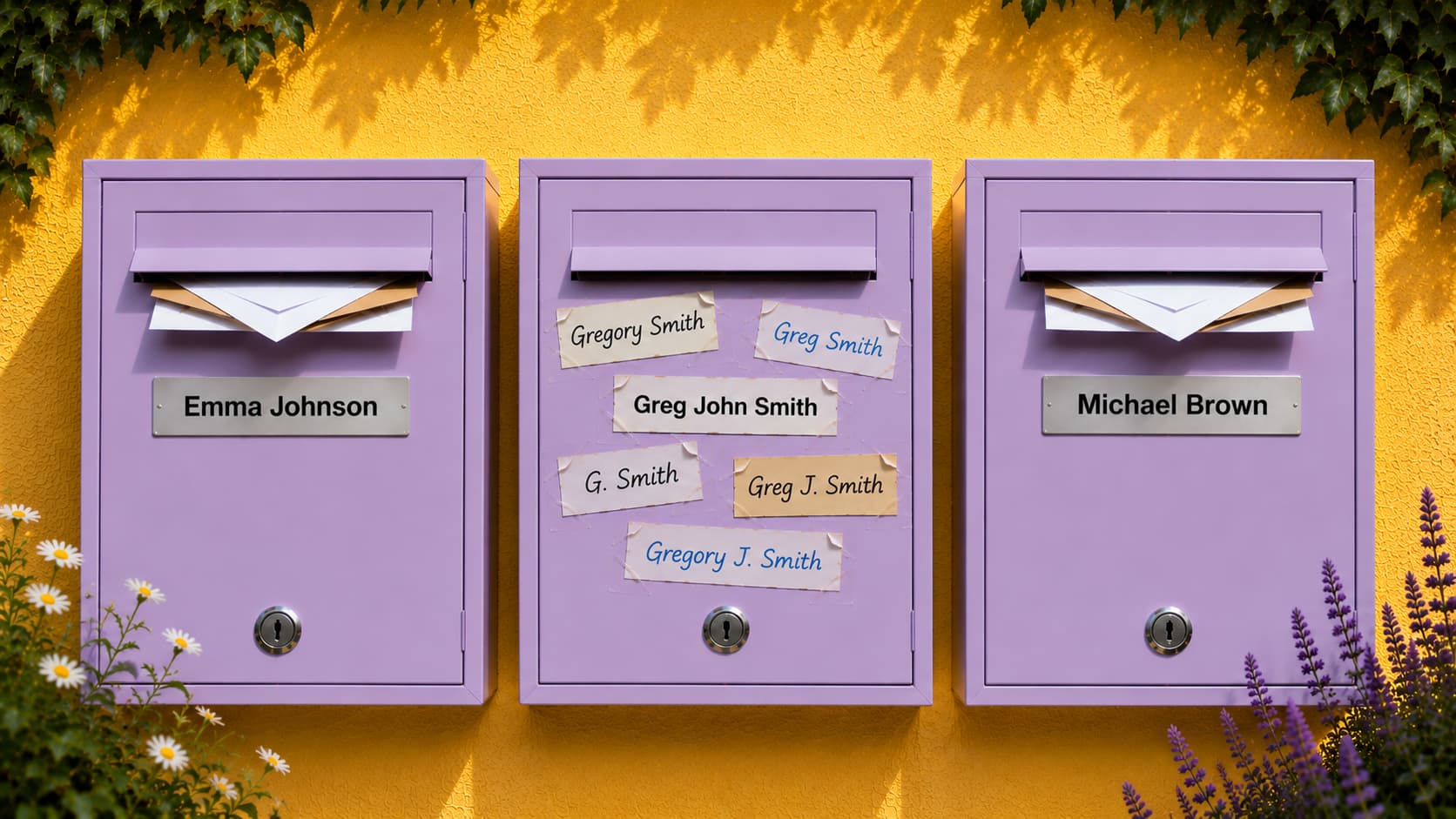
An interested party for application coaching first contacted me by phone, then sent me his CV using his business e-mail address. On it, however, his private e-mail address and a different mobile number were listed. According to the CV, he had two first names. The business e-mail address contained the first; he signed his message with the second. Confusion – before we had even begun working together.
Should I reply to the business e-mail address or, for reasons of discretion, use the private one? Does he check that regularly – given that his enquiry appears time-sensitive? I must be careful to distinguish between the business and the private number so as not to put him in an awkward position with an ill-timed call. So many considerations arising from a simple question: “What is your name and how can I reach you?”
Anyone who has ever recruited knows: such ambiguities create additional effort. In a dried-up labour market, that may matter less.
Friction costs opportunities
I encounter similar situations regularly: clients who say their name so quickly that I have to ask more than once (see article: “My Name is Bond – James Bond”). Coachees with double-barrelled surnames that they sometimes use and sometimes omit. Or first names that prompt me to check LinkedIn before I can address the person correctly.
What appears to be a minor side issue is not trivial at all. Addressing someone correctly is a matter of respect. Doing so via the right channels is a matter of efficiency – and discretion.
Especially in times of information overload, simplicity is decisive. If things become too complicated, the recruiter moves on to the next candidate – provided there is a choice. The same applies not only to the labour market, but equally to the market for service providers. I, too, have paid my tuition fees in this regard.
Playing memory for company founders
What it means to be poorly addressable, I learnt during my coaching education. One of our course leaders asked the sixteen participants to stand up. Holding a ball, she explained the game: each person was to think of a number – any size. Not wishing to make it too easy, I chose a four-digit number: 5387. She threw the ball to someone, who announced their number. As the game progressed, we threw the ball to one another – and whoever could correctly name the “address” of the person received a point.
When I caught the ball, I said: 5387. With wandering eyes, my fellow player tried to memorise it. I passed the ball on to number 8 – my first and, as it turned out, last point. Thereafter, numbers 8, 5, 7 and 10 played among themselves. Those of us with three- and four-digit numbers were left out.
It was frustrating – I like to win. Since then, I have made a conscious effort to make it as easy as possible for prospective clients to find me.
Companies invest heavily in a consistent corporate design to simplify how they are perceived. Why should you apply less care to your personal design? Visibility does not begin with volume, but with clarity. Those who are unmistakably recognisable are addressed more easily – and remembered.